Feel the noise with multimodal HMI combining haptic and sound

By Stefano Rosato | 28 October 2026

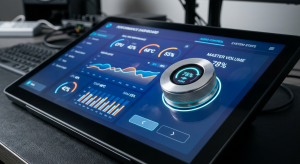
When we touch, we like to feel. When we press our fingers against something, our brains have been conditioned to expect some kind of feedback. So, if we tap a flat screen and get nothing in return – no physical or audio response – it doesn’t feel right. Which is why we are introducing new Human-Machine Interface (HMI) solutions that combine Piezo Haptic Technology with Sound Actuators (Exciters).

The solution integrates two complementary technologies to bring the display surface itself to life, creating an interplay between feeling and sound that satisfies our need for feedback.

Piezo haptics create ‘the click’

Central to the haptic solution are piezoelectric actuators. Through the piezoelectric effect, electricity causes the material to physically flex and since piezo elements react extremely quickly (often under one millisecond), they can generate an immediate, precise movement that feels like the click of a real mechanical switch. Unlike conventional motors that are slow to start up, piezo elements have high-definition haptic feedback capable of simulating various textures or click strengths.

Sound Actuators turn the surface into a speaker

For a more holistic experience, we’ve combined haptics with sound actuators (or exciters, as you might know them). These make the display surface or cover glass vibrate, as a speaker cone might, so the sound emits directly from the touched surface. Because the piezo elements are very compact and have no rotating masses, they sit perfectly in flat designs.

Together they create a truly multimodal experience. A user touches an icon on the display and simultaneously feels a palpable impulse and hears a clear acoustic signal, telling the brain that the touch has been effective. However, it is the synchronization that is crucial to this sense of complete confirmation. It can drastically improve operational safety, as the feedback even enables ‘blind operation’ in vehicles or while operating machinery.

And because there are no speaker openings or mechanical keys, the surface is completely sealed and resistant to water and dust, making it ideal for harsh industrial settings and sterile medical environments. Piezo elements are also extremely thin, so can be used for slim designs that wouldn’t be possible with traditional ERM/LRA motors.

However, fine-tuning both systems can be a technical challenge if you want to avoid interference and create a harmonious user experience. Of course, we have this covered and we support our customers in calibrating actuators so that frequency, amplitude and waveform are exactly matched to the housing and cover glass.

By blending piezo power with audio exciters, we turn flat screens into responsive displays that feel safe, sleek and premium.

Our display solutions come in a range of form-factors, and our display-experts are on hand to guide you in the creation of display or touch solutions that meet your requirements. Find out how Avnet Displays can propel your product innovation and get in touch today.

Other articles